Launching a startup in 2026 is not easy task, just about having a great idea not enough—it’s about choosing the right funding platform at the right stage. Crowdfunding has evolved from a simple fundraising tool into a full-scale validation, marketing, and community-building engine.
However, not all crowdfunding platforms are parallel. Some are ideal for product launches, others for equity fundraising, and a few excel at community-driven or mission-based startups.
This guide breaks down the 12 best crowdfunding sites for startups in 2026, based on real-world execution factors—not marketing hype.
Best for: High-growth startups planning long-term equity fundraising
Funding type: Equity crowdfunding
Record Revenue achievement:
they achive over $92 million in revenue year-to-date (YTD) with nearly 3x year-over-year growth, reporting profitability with $4.9M GAAP net income in H1 2025. StartEngine continues to dominate the US equity crowdfunding market in 2026. It enables startups to raise capital from both accredited and non-accredited investors under Reg CF and Reg A+ frameworks.
Why founders choose it
Key consideration:
This is not an MVP-stage platform. Legal, financial, and reporting readiness is mandatory.
Best for: Product, hardware, design, and tech startups
Funding type: Rewards (all-or-nothing)
Kickstarter remains the gold standard for product validation. In 2026, success depends less on the idea and more on pre-launch preparation.
Strengths
Limitations
Best for: Global product launches and flexible funding
Funding type: Rewards / Flexible
Indiegogo is ideal for startups that want global reach and the ability to keep funds even if goals are missed.
Notable advantage
Trade-off:
Lower organic discovery—paid traffic plays a larger role.
Best for: Startups targeting future VC rounds
Funding type: Equity / Debt
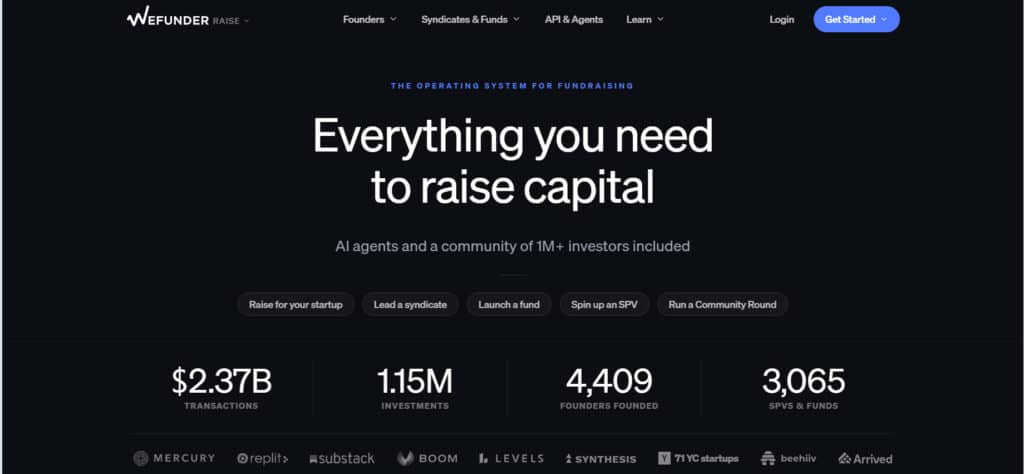
Wefunder is one of the most founder-friendly equity platforms, combining accessibility with investor credibility.
Why it stands out
High campaign success rates when prepared correctly
Best for: US-based startups seeking structured fundraising
Funding type: Equity & Rewards (subscription-based)
Fundable operates on a flat monthly fee rather than success commissions, making it cost-efficient for experienced founders.
Best use case
Best for: UK & European startups
Funding type: Equity
Crowdcube is the leading equity crowdfunding platform in Europe, widely used by early-stage and growth-stage startups.
Unique advantage
Constraint:
Geographically limited and compliance-heavy.
Best for: Creator-led and content-driven startups
Funding type: Subscription
Patreon isn’t a traditional startup platform—but in 2026, recurring revenue models are increasingly attractive to bootstrapped founders.
Ideal for
Best for: Social, environmental, and mission-driven startups
Funding type: Donation
While not ideal for commercial ventures, GoFundMe works well for impact-first startups and early proof-of-concept funding.
Best for: Late-stage and scale-ready startups
Funding type: Equity
MicroVentures bridges private equity and crowdfunding, hosting fewer but higher-quality investment opportunities.
Best for: Nonprofits and cause-based startups
Funding type: Donation
Offers CRM, donor management, and marketing tools alongside fundraising.
Best for: Women-led startups
Funding type: Rewards / Grants
Combines crowdfunding with coaching, grants, and brand partnerships—making it a strategic ecosystem rather than just a platform.
Best for: Early to growth-stage startups seeking diverse investor access
Funding type: Equity, debt, and crypto
Republic is a modern crowdfunding platform that enables startups to raise capital from a broad mix of retail and accredited investors. It stands out for supporting multiple funding models—including equity, revenue-sharing, and tokenized investments—making it a flexible option for startups looking to scale while building a strong investor community.